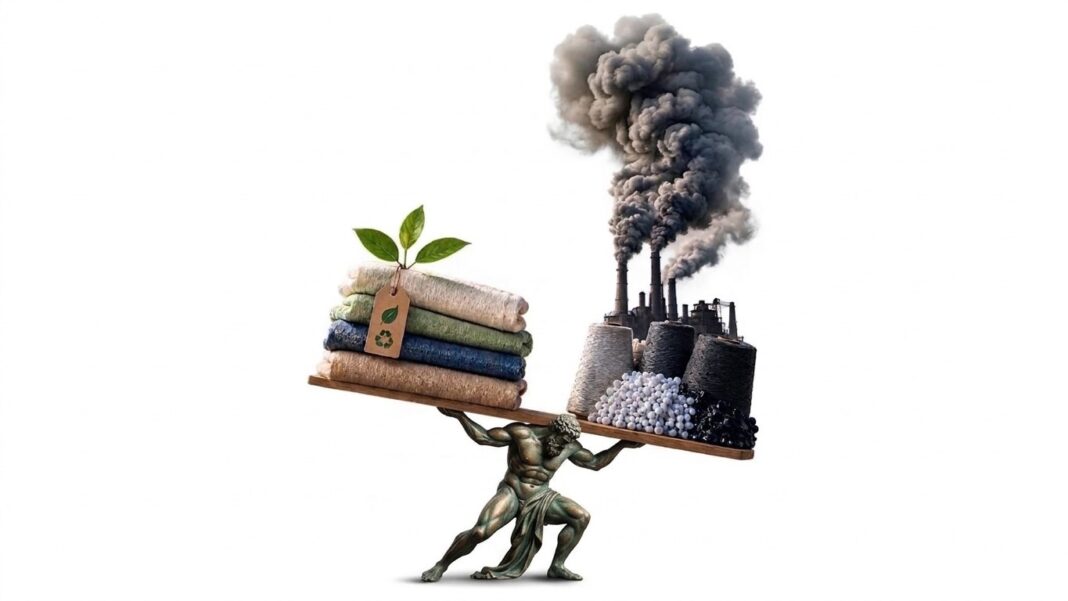


New methods and processes aimed at making textile products more sustainable are being adopted at an increasing pace. From global apparel brands to textile technology manufacturers, many industry players are forming new partnerships to make supply chains more sustainable. However, while these initiatives are expected to reduce emissions, greenhouse gas emissions from the production of raw materials used in the apparel, home textiles, bags and footwear sectors reached a record high in 2025. It seems that as the volume of products manufactured continues to increase, improvements achieved on a per-unit basis are not enough to reduce the overall environmental impact. In other words, the numbers simply don’t add up in textiles.
Progress is being made, but the problem continues to grow
The textile industry is increasing its investment in new materials, production technologies and recycling solutions to reduce its environmental impact. Companies are working to reduce energy and water consumption, improve production processes and turn to raw materials with a lower environmental impact. Given that the aim of all these efforts is to combat the climate crisis, which has reached serious proportions, and to adopt an ecology-centred approach instead of a human-centred system, it would be reasonable to expect an overall improvement. However, the data tell a different story.
According to Textile Exchange’s 2026 Materials Market Report, the figures for the apparel, home textiles, bags and footwear sectors are as follows:
Greenhouse gas emissions reached a record high of approximately 325 million tonnes of CO₂e in 2025. Emissions increased by approximately 30% compared with the 2019 baseline.
In 2025, polyester accounted for approximately 43% of greenhouse gas emissions associated with raw material production for these sectors. Most of this came from virgin fossil-based polyester. Polyester thus continued to be the fibre with the highest emissions impact.
According to the same report, global fibre production increased from 132 million tonnes in 2024 to 139 million tonnes in 2025. Polyester, which accounted for 59% of global fibre production, also increased in volume over the same period, rising from 77.7 million tonnes to 82.5 million tonnes. Moreover, 72.8 million tonnes of the polyester produced in 2025 were based on virgin raw materials derived from fossil resources.
According to data shared by the Apparel Impact Institute, emissions from the apparel value chain increased by 6.3% year on year in 2024.
Although recycled polyester production reached 9.7 million tonnes, 97% of it was derived from plastic bottles. The share of fibres recycled from textiles in total global fibre production remained at just 0.76%. Although producing polyester from plastic bottles enables waste to be recovered and reused, the fact that fibres derived from textile waste account for only 0.76% of total fibre production shows that the transition in this area remains limited.
These figures do not, of course, show that sustainability efforts have been unsuccessful. On the contrary, they reveal the scale at which the transition is taking place and how much further there is to go. However, if total production continues to grow while demand for virgin raw materials remains high, the overall impact of these gains needs to be assessed in context.

Why are global textile industry emissions continuing to rise despite all these efforts?
When assessing the textile industry’s efforts to meet its climate targets, production volumes and consumption habits must also be taken into account. Production is not determined solely by the efficiency of machinery; various other factors, such as the volume of products placed on the market, consumer demand, product lifespans and business models, also play a role in this equation.
Data from the European Environment Agency (EEA) show that the relationship between the two is not straightforward. In 2022, greenhouse gas emissions from the supply chains serving textile consumption in the European Union reached 159 million tonnes of CO₂e. Nevertheless, between 2010 and 2022, per capita textile consumption increased by 15%, while per capita greenhouse gas emissions decreased by 22%. In other words, consumption and per capita emissions did not move in the same direction in the EU during this period.
However, this does not mean that the increase in consumption is insignificant. The EEA states that emissions associated with textile consumption generally remained stable after 2015, fell in 2020 and 2021 due to the pandemic, and then rose again.
Therefore, the right question is not whether increased production leads to higher emissions, but to what extent efficiency gains reduce the overall impact on a global scale. This distinction also changes how sustainability performance is measured. Lower emissions per product, reduced water consumption and a higher share of recycled content are all important indicators. However, unless these are considered alongside total production, resource use and absolute emissions, they present an incomplete picture of the industry’s overall progress.
The rules are changing, and so must the way we measure progress
Turning sustainability targets into tangible results depends on more than companies’ voluntary initiatives. Regulations governing how products are designed, what information they carry and the conditions under which they are placed on the market also influence the direction of the transition.
The European Union’s Strategy for Sustainable and Circular Textiles and the Ecodesign for Sustainable Products Regulation (ESPR) are among the key elements of this change. Textiles and apparel are among the priority product groups in the ESPR Working Plan for 2025–2030. According to the European Commission’s current timetable, the delegated act containing textile-specific digital product passport and ecodesign requirements is scheduled for adoption in the fourth quarter of 2027.
However, regulatory compliance and reducing environmental impact as a whole are not the same thing. The industry’s transition will depend not only on compliance with new rules, but also on how these rules change production decisions and business models.
COP31: From targets to implementation
COP31, which Türkiye will host in Antalya from 9 to 20 November 2026, represents an important opportunity to turn climate targets into concrete action through new partnerships.
Green industrialisation is among the priorities of the COP31 Presidency Action Agenda. One of the targets announced in this context is to increase circular material use in production and manufacturing sectors by at least 15% by 2035.
Increasing circular material use requires more than incorporating a greater share of recycled fibres. It requires a series of measures extending from waste collection and sorting to recycling infrastructure, technology investments and financing. Converting textile waste back into fibres, separating different materials and bringing recovered raw materials to a quality suitable for use in production are among the important stages of this process. At the same time, all of these measures must be implemented at viable costs.
For the textile industry, the main issue is not how much visibility it gains during the summit, but how this period can be used to accelerate concrete action. New partnerships between public institutions, manufacturers, technology providers and industry organisations could create new opportunities in terms of access to finance and the transformation of production processes.
Redefining success
To assess whether the textile industry is progressing towards its climate targets, it is not enough to look only at new technologies, materials and production processes. Reducing energy consumption per unit, increasing the use of recycled fibres and improving the transparency of product information are important gains. However, their impact on total production volumes, resource consumption and absolute emissions must also be measured.
Just as it would be wrong to equate growth with environmental failure, equating increased production with economic success is also insufficient. The real issue is how the relationship between economic activity and environmental impact is changing and whether this change is lasting. The industry’s progress should be assessed not only in terms of its ability to produce more efficiently, but also by the extent to which these efficiency gains translate into overall environmental outcomes. Rethinking textiles requires us to question not only how we produce, but also the criteria by which we assess the performance of the system extending from production to consumption.
If fashion continues to dazzle in New York, Paris and London while the environmental burden of textiles continues to be felt in the air, water and factories of Dhaka, Cairo and other production centres, a sustainable future will remain a false spring.
