



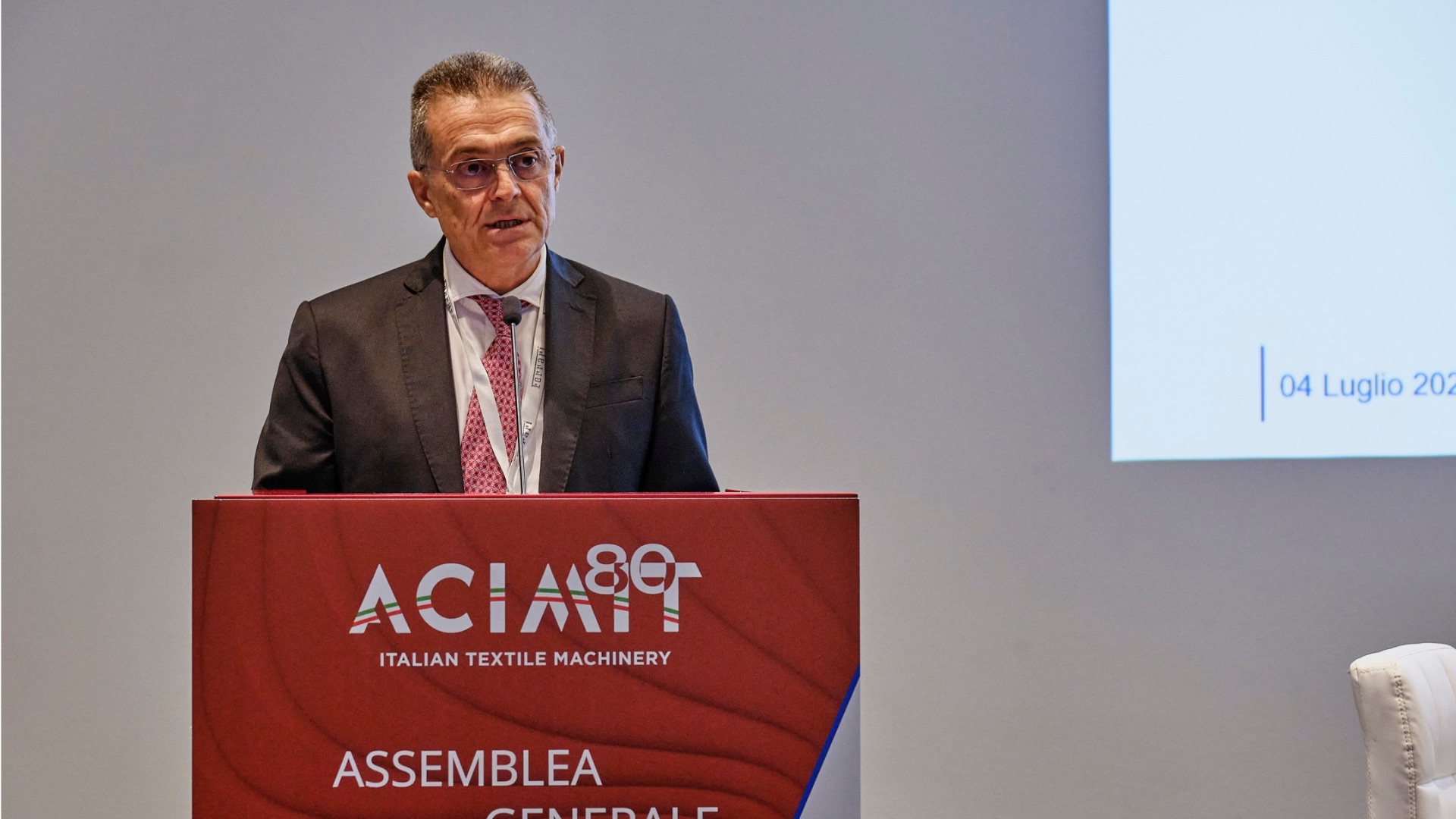

As the global textile industry turns its focus to the upcoming ITMA ASIA + CITME 2026 exhibition, Marco Salvadè, President of the Association of Italian Textile Machinery Manufacturers (ACIMIT), shared exclusive insights with Textilegence on the sector’s 2026 performance. Noting that textile manufacturers’ appetite for technological renewal persists despite global economic uncertainties, Salvadè said the most fundamental shift has occurred in the investment mindset.
Pointing out that Asia has reinforced its lead in Italian textile machinery exports—reaching €264 million in the first half of 2026 and accounting for 37% of total exports—Salvadè said: “Manufacturers now prioritise technologies delivering measurable productivity, flexibility, and sustainability over simple capacity expansion; they seek long-term partners to support their competitiveness rather than mere machinery suppliers.” Affirming Italy’s strong participation at ITMA ASIA + CITME 2026, he invited all visitors to explore Italian machinery technologies up close.
Regional markets diverge as Türkiye holds its strategic position
Noting that this qualitative shift in Asia directly aligns with the diversification of the global manufacturing map, Marco Salvadè said each region is pursuing investment strategies tailored to its own industrial structure. He noted that while China focuses on value-added production and India and Vietnam drive industrial modernisation, Europe prioritises automation and energy efficiency, and the Americas focus on regional supply chain development and facility upgrades.
In this global equation, Salvadè emphasized that Türkiye remains an indispensable partner for Italian technology suppliers with its strong manufacturing expertise and strategic location, pointing to its long-term potential despite the recent slowdown caused by cautious capital expenditure. He reported that Italian textile machinery exports to Türkiye reached €87 million in 2025 and €41 million in the half of 2026. Highlighting that finishing machinery accounted for 28% of H1 exports, followed by spinning (22%), weaving (21%), and accessories (16%), Salvadè projected that investments in automation, energy efficiency, and flexible production will regain momentum in Türkiye.
Lifecycle cost and the green transition prove decisive
Explaining that shifting market demands have also reshaped capital expenditure decisions, Marco Salvadè stressed that initial purchase price is no longer the sole determinant, as energy consumption, maintenance requirements, and total lifecycle cost now carry equal weight. Stating that AI and digitalisation create value insofar as they deliver tangible benefits in predictive maintenance, quality control, and data-driven decision-making, he added that seamless integration with existing production lines is critical.
On the sustainability front, Salvadè noted that technologies reducing water and chemical consumption in finishing, minimising raw material waste, and facilitating recycled fibre processing stand out. Recalling that ACIMIT’s CLIMA project transparently demonstrates machinery’s environmental performance, Salvadè said they view Germany’s “Textilfabrik 7.0” initiative not as a rival national strategy, but as a cooperation opportunity to strengthen the European value chain.
Supply security and the roadmap to ITMA 2027
Emphasising that they provide uninterrupted technical support through supply chain diversification and transparent communication amid rising geopolitical tensions and logistical challenges, Marco Salvadè stated that solutions for automation, AI, circularity, and technical textiles will shape the industry in 2027. He added that this innovative vision, taking concrete shape at ITMA ASIA + CITME 2026, will be carried even further at ITMA 2027, to be held in Hannover on 16–22 September 2027 under the theme “Co-creating the Future of Textiles.”
Noting that their commitment for 2027 goes beyond offering advanced machinery to directly supporting manufacturers in boosting competitiveness and transitioning to more sustainable production, he concluded: “As an association, we will continue to foster international cooperation, facilitate dialogue between technology suppliers and textile manufacturers, and back initiatives supporting knowledge sharing.”