




From heart rate monitoring t-shirts to motion-tracking athletic wear, smart textiles are becoming increasingly common. Now, researchers want to give fabrics a new feature: shape-shifting capabilities.
Fabrics have no memory. Pull on a sweater sleeve, and it snaps back into place. Wrinkle a shirt, and it stays creased. We generally know how fabrics behave.
However, researchers at Harvard University have developed a textile that challenges what we know. At first glance, this seemingly ordinary knit fabric can switch between different shapes and maintain whichever form it settles into. What is more, it can do this not just once, but multiple times.
At the core of the research lies a phenomenon physicists call “multistability”. It refers to a system’s ability to exist in more than one stable configuration. One of the simplest real-world examples is a light switch. The switch is either on or off, and it remains stable in both states. The Harvard team successfully engineered this exact behavior into knitted textiles.
Unusual behaviors with ordinary yarns
One remarkable aspect of the study is that this was achieved not with exotic materials but using standard industrial knitting techniques long employed by the garment industry.
Researchers produced dense, thick textiles by choosing highly elastic yarns. Utilizing a special technique called plating—which exposes different yarns on each face of the fabric—the structure naturally curled to form three-dimensional shapes. The result was snap-like textile structures capable of abruptly shifting between different configurations.
By systematically combining horizontal and vertical patterns in various ways, the research team mapped the exact physical regimes in which the fabrics would exhibit this behavior. This clearly illuminated the relationship between the geometry of the design and the material’s mechanical response.
More than just a material experiment
The importance of the new fabric lies less in the movement it displays and more in its functional applications.
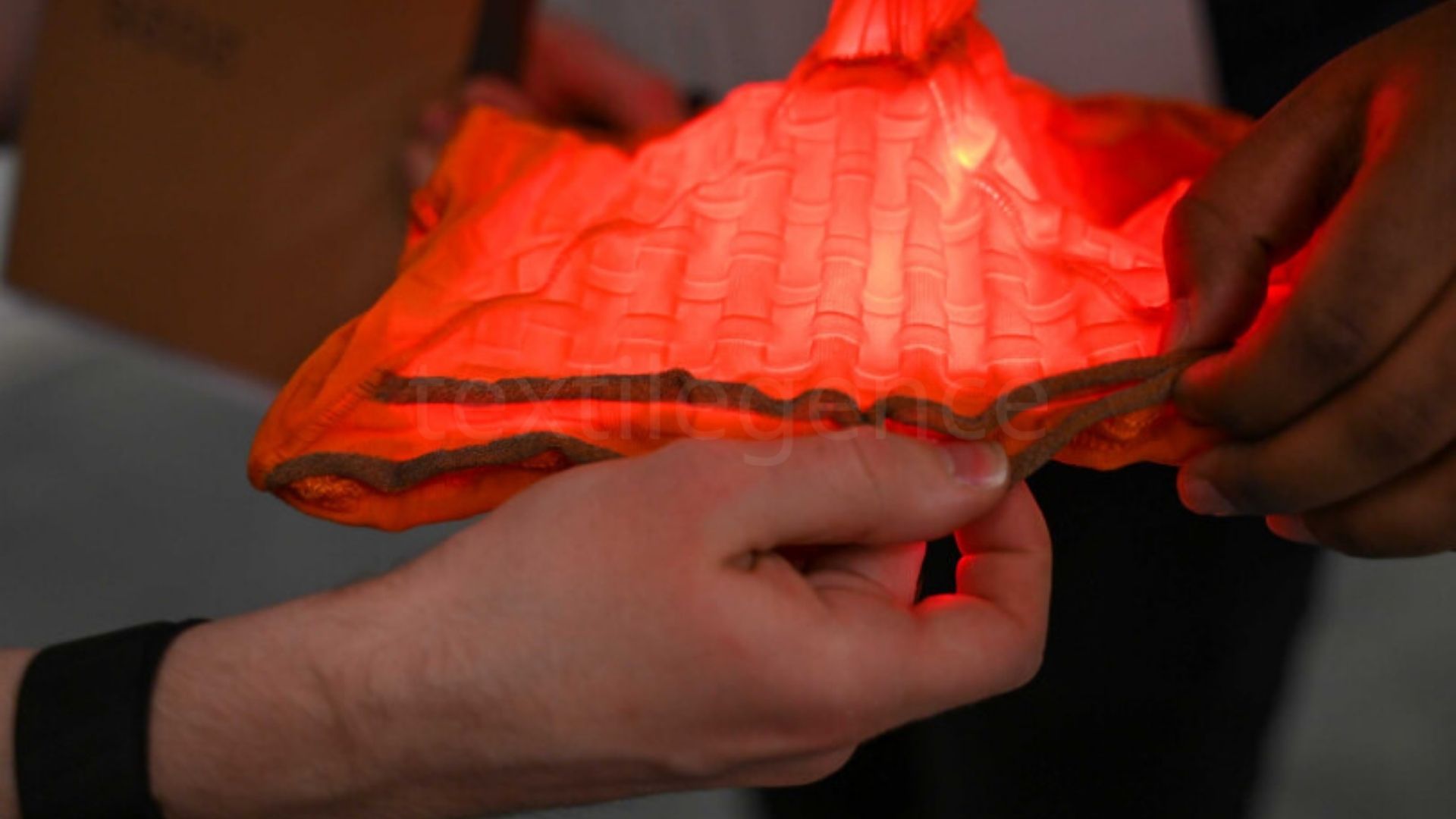
When researchers embedded fine conductive yarns into the fabrics, the shape-shifting structure doubled as an electrical switch. As the textile snaps from one state to another, the circuit changes as well. This opens up possibilities for soft, flexible, and stretchable electronic components.
To demonstrate this, the team developed various prototypes. One features a multistable shell shape that turns an LED light on and off as it flips between states. Another consists of a wearable textile switch placed over the knee or elbow, which senses movement transitions to count steps.
Researchers also designed a reconfigurable lamp shade that produces different colours of light corresponding to the fabric’s various states. Each stable configuration corresponds to a distinct light colour.
A new step for smart textiles
Looking at it today, this work might seem like an interesting story about a shape-shifting fabric.
Yet researchers point to far broader possibilities. Garments that monitor human movement, textiles that provide tactile feedback, or wearable systems that morph into new shapes on demand are all among the future applications of this approach.
Perhaps the most notable detail is that all of this can be manufactured using systems remarkably similar to standard industrial knitting machines already used in garment factories. This indicates that the technology’s path from the laboratory to the factory floor may not be as long as one might think.