



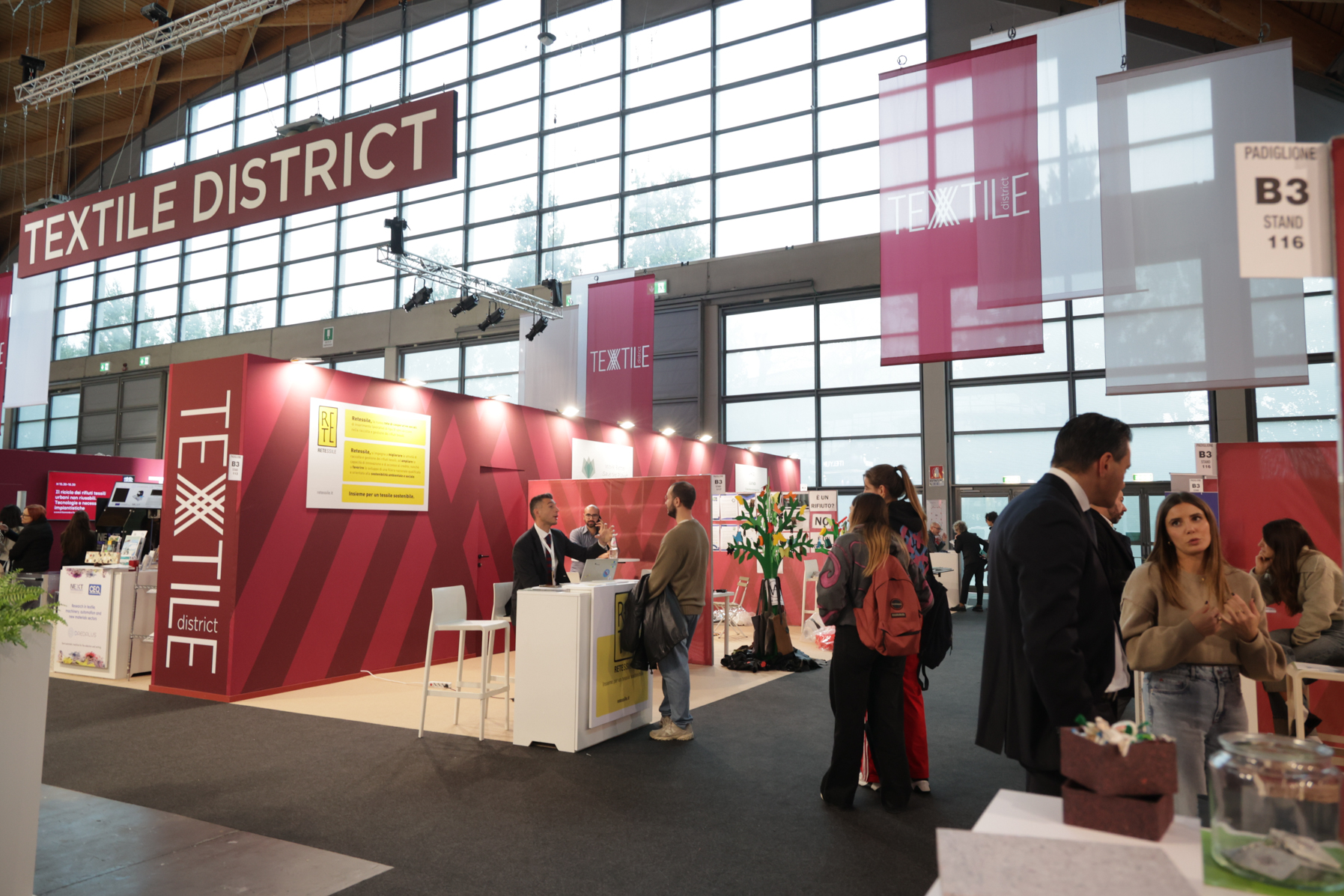

Ecomondo 2026, the international event organised by Italian Exhibition Group and dedicated to the ecological transition, strengthens its focus on textile at its 29th edition. The event, scheduled to take place from 3 to 6 November at the Rimini Expo Centre, in Italy, will further expand the space dedicated to the sector, transforming what was until last year known as the Textile District into an independent exhibition sector that will occupy an entire hall, joining the other six sectors traditionally featured at Ecomondo – Waste as Resource, Water Cycle & Blue Economy, Sites & Soil Restoration, Circular & Regenerative Bio-economy, Bio-energy and Agriculture, Earth Observation & Environmental Monitoring – and its districts.
Furthermore, with the Textile Experts Board, a spin-off of the Technical and Scientific Committee, Ecomondo has established a permanent forum for dialogue between institutions and industry, aimed at organising expert discussions and promoting dialogue focused on the development of increasingly sustainable and innovative models for the sector.
Ecomondo 2026 is turning into a collaboration platform
The new exhibition area dedicated to textiles has been created to provide a forum for dialogue and collaboration for all those involved in the sector’s development, with the aim of fostering discussion on key issues for the industry, such as sustainability, technological innovation, transparency and traceability throughout the supply chain. It is a space designed to bring together different skills, approaches and experiences, thereby stimulating the development of new solutions for the sector.
Within the Textile sector, all the main stages of the materials’ life cycle will be represented, from production to eco-design, including the collection, sorting, treatment and recycling of textile components, right through to emerging trends linked to the second-hand market and developments in the regulatory framework. The area will bring together manufacturing companies, operators in the textile machinery and recycling sectors, organisations active in the recovery of pre- and post-consumer waste, as well as research centres, laboratories, digital and artificial intelligence expertise, alongside consortia and trade associations.
Textile importance in circular transition
In the transition towards more sustainable production models, the textile sector plays a key role and is undergoing significant transformation across Europe, with more than 260,000 companies generating over €160 billion in turnover.
Identified by the United Nations Environment Programme (UNEP) as a contributor to the “triple planetary crisis” linked to climate change, pollution and biodiversity loss, the sector is now being reshaped by new EU policies, including the EU Strategy for Sustainable and Circular Textiles, separate textile waste collection, Extended Producer Responsibility (EPR) schemes, the Ecodesign Regulation, the digital product passport and the ban on destroying unsold goods. Furthermore, in 2025, the requirement for separate collection of textile waste came into force across the EU.