




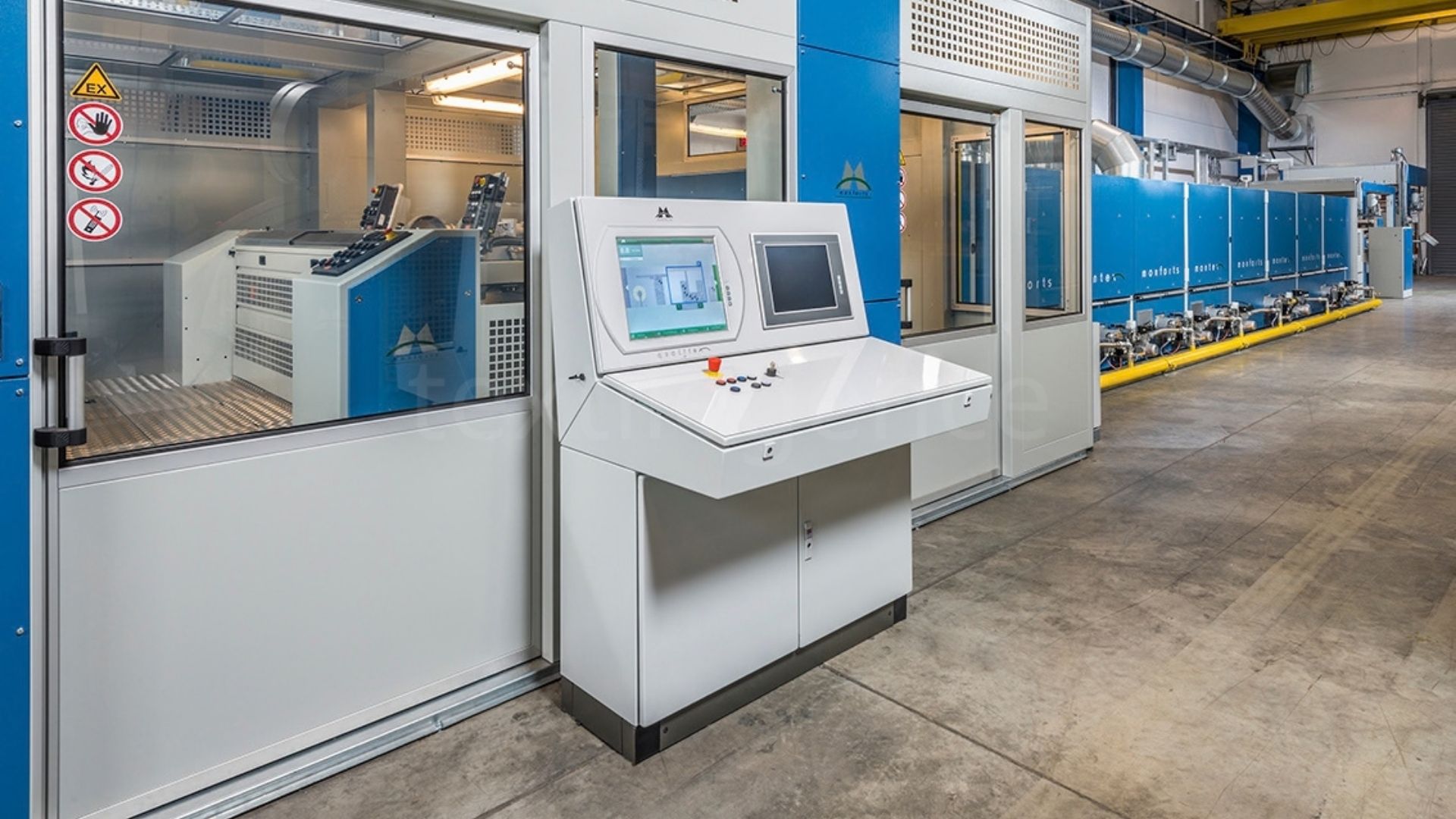

Textile finishing technology specialist Monforts is supporting customers in transferring new products and processes from the laboratory stage to industrial production through its Advanced Technology Centre (ATC) in Mönchengladbach, Germany. Originally opened in 2013 and subsequently expanded, the facility now operates across an area of 1,200 square metres.
Monforts Marketing Manager Nicole Croonenbroek said: “The ATC allows our customers to test their own textiles and technical fabrics on Monforts dyeing and finishing machines under fully confidential, real production conditions. Using the results from these trials, we are also able to make recommendations for improving many fabric finishes.”
The ATC houses two full MONTEX finishing lines, a THERMEX range for the continuous dyeing of denim and other woven fabrics, a full colour kitchen and a number of lab-scale systems for smaller batch trials. Through the trials carried out at the centre, manufacturers can evaluate new fabrics and finishing applications under real production conditions before investing in their own facilities.
Dedicated line for technical textiles
The ATC’s dedicated technical textiles line has been designed to process materials with widely differing performance requirements. The line incorporates a four-chamber horizontal chain MONTEX stenter and an explosion-proof coating application chamber that enables processing with organic solvents and other volatile materials.
In addition to operating at temperatures of up to 320°C, the system can process the upper and lower surfaces of certain materials at different temperatures during a single pass. This capability provides advantages in applications such as floorcoverings, where textile surfaces and rubber backings require different treatment conditions, PVC flooring employing chemical foams, and heavily backed blackout roller blind fabrics. It also enables the careful processing of organic solvents used in applications such as antiseptic treatments in the pharmaceutical industry, where highly specific temperature conditions are required.
Digital application reduces resource consumption
The technical textiles line has recently been equipped with a Baldwin TexCoat™ G4 digital spray unit. Used in combination with Archroma’s latest sustainable finishing chemistries, the system enables precise application of water-based chemicals including softeners, antimicrobials, water repellents and flame retardants.
According to Monforts, when combined with MONTEX stenters, the TexCoat G4 can reduce water, energy and chemical consumption by up to 50% compared to conventional pad application processes.
Gentle treatment for knitted fabrics
The second production line at the ATC is dedicated to knitted fabrics. Based around a MONTEX stenter with vertical chain return, the system operates under low and precisely controlled tension, helping to preserve fabric elasticity while ensuring uniform thermal treatment.
The line is also equipped with the Eco Applicator system, which provides an alternative to conventional wet-on-wet padder. By reducing the moisture content of the fabric entering the stenter from 60% to 40%, the technology lowers energy consumption while also enabling different chemicals to be applied to either one side or both sides of the fabric.
THERMEX and energy recovery
The Econtrol® process enables reactive dyestuffs to be fixed into the fabric during a one-step dyeing and drying process through a controlled combination of steam and air. The continuous dyeing method allows dyeing and drying operations to be completed in just two to three minutes at temperatures of 120-130°C.
The THERMEX line has also recently been equipped with the Monforts Universal Energy Tower, which recovers heat from exhaust air generated during thermal processes, delivering energy savings of up to 25% depending on operating conditions.
Monforts emphasises that the key value of the ATC lies in its ability to validate new fabrics, finishing applications and production technologies not only in the laboratory, but also under real industrial conditions. As a result, textile manufacturers can determine optimum process parameters and make more reliable technical and economic investment decisions before implementing new production systems.