


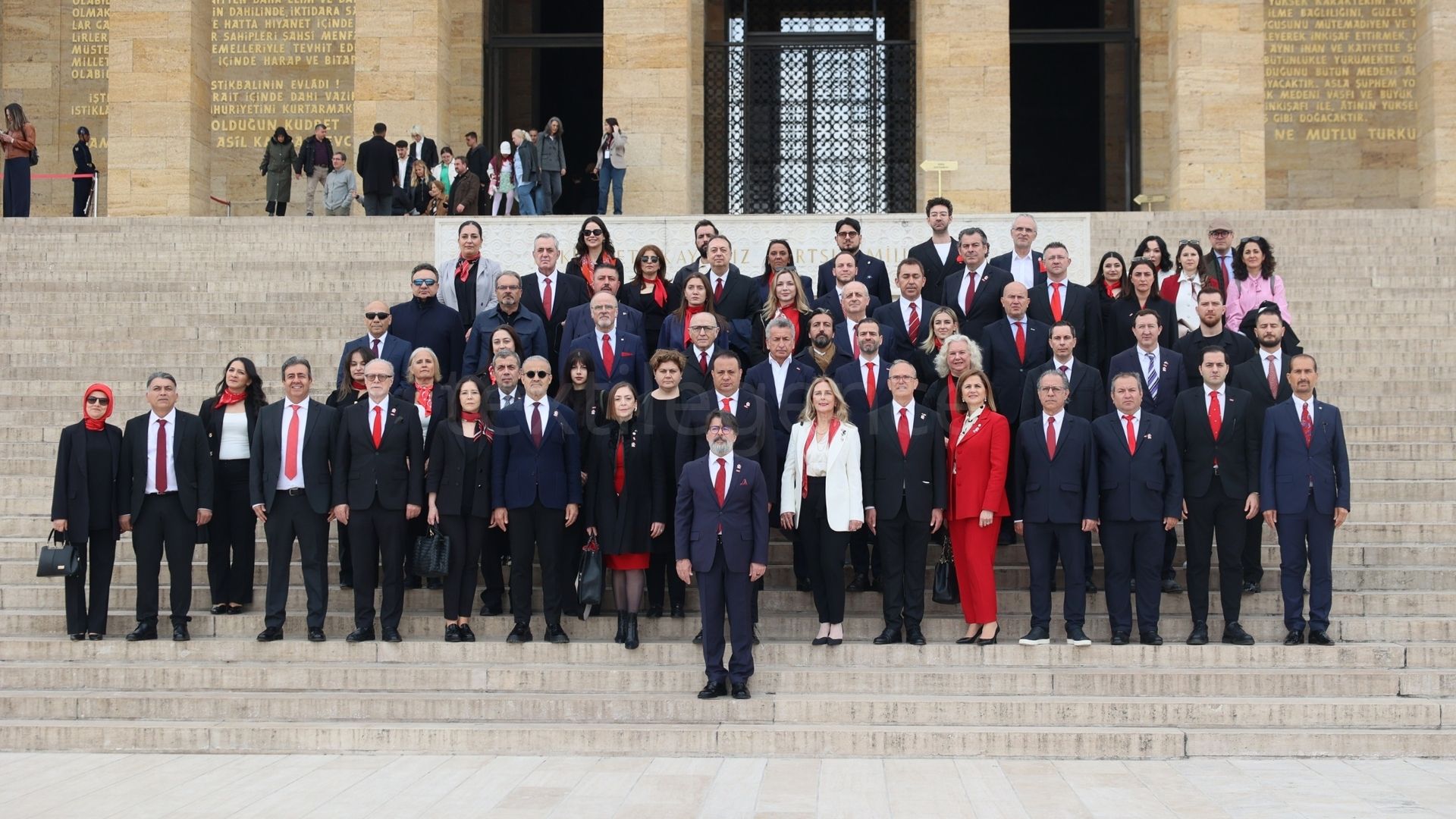

The umbrella organization of Türkiye’s apparel sector, the Turkish Clothing Manufacturers’ Association (TGSD), celebrated its 50th anniversary in Ankara. The first part of the program, hosted by TGSD Co-Chairs Dr. Ümit Özüren and Toygar Narbay, included a visit to Anıtkabir by the Board of Directors and association members. After laying a wreath at the mausoleum of Mustafa Kemal Atatürk, the delegation observed a moment of silence. Following the visit to Anıtkabir, the TGSD 50th Anniversary Gathering was held with the participation of representatives from the private sector and NGOs.
TGSD Co-Chair Dr. Ümit Özüren wrote the following in the Anıtkabir Special Book, stating that in the new period they aim to strengthen the apparel industry together with the “Türkiye Brand”:
“Thanks to the vision you have shown to our nation, we believe that working, producing, industrializing, and transforming economic strength into national strength is one of the strongest guarantees of our independence. Today, our responsibility is to make our industry more competitive, qualified, sustainable, and strong; to transform labour, knowledge, design, innovation, and entrepreneurship into a shared value for the future of Türkiye, and to carry the ‘Türkiye Brand’ forward more strongly.”
“We must strengthen labour-intensive industries such as apparel against the risk of deindustrialization”
Stating that Türkiye must preserve its industrial capacity in a period when global production balances are being reshaped, TGSD Co-Chair Toygar Narbay noted that the ratio of goods exports to GDP is an important indicator of industrialization level. “While this ratio was at 27% in 2022, it fell below 18% by the end of 2025; the ratio projected for 2028 under the Medium-Term Program is 16.4%. With the global average around 22–25%, this picture clearly reveals that we are facing the risk of deindustrialization. For Türkiye, the issue is not abandoning labor-intensive sectors, but upgrading them to a new level with higher productivity, strong design capacity, advanced technology use, and higher brand value,” he said.
“We see the cost of moving away from production in the European example”
Emphasizing that Europe’s long-standing approach of outsourcing a significant portion of its production to third countries has today resulted in technological stagnation, strategic dependency, fragile supply chains, and job losses, Narbay stated that China, on the contrary, did not push low- and mid-technology production out of the system but built high-tech and innovation capacity on top of these areas. “When a country’s production base weakens, it does not only lose current capacity; its future potential in design, technology, branding, and innovation also shrinks,” he said.
“If the right steps are taken, 2026 may be the first threshold of repositioning in apparel”
Commenting on the remainder of the year, Narbay said: “Global demand, geopolitical risks, energy and logistics costs, and financing conditions will be decisive for our industry. Due to developments in the Gulf region, orders have temporarily shifted to our country. If steps that enhance competitiveness are taken in this period, stabilization can be achieved and we can return to a recovery path. However, rather than a sharp rebound by year-end, a scenario that prevents deeper losses and ensures balance appears more realistic. If no additional deterioration occurs in domestic and external conditions and new supply chain searches are supported by the right economic policies, the industry may begin to move above water in the second half of the year.
We do not see this year only as an outcome year; if the right steps are taken, 2026 may be the first threshold of repositioning in apparel. For this reason, the 2026–2028 stabilization period is critically important. In this process, steps such as ‘a 10% exchange rate conversion support for net exporters’, ‘graduated support of 3,500 TL based on regional development levels, increased to 6,000 TL for the 6th Region with 3% tolerance for wider application’, ‘benchmarking rediscount interest rates at 50% of the policy rate and collecting interest at the end of the period for a more sustainable cost structure’, ‘KGF support for Eximbank guarantees’, ‘reducing burdens on raw materials’, and ‘facilitating inward processing regime (DİR) operations’ are necessary not only to manage the present but also to generate resources for the transformation period beyond 2028.”